Insights on the Digital Transformation of Higher Education: Transformation Paths in Southeast Asia
The readiness of higher education institutions(HEIs) for digital transformation is a key factor determining their ability to effectively adapt to the integration of artificial intelligence(AI) into education. Since 2023, the International Centre for Higher Education Innovation under the auspices of UNESCO (UNESCO-ICHEI) has collaborated with UNESCO regional offices, category 1 institutes, regional and international organizations, and higher education research institutions to conduct joint research. This includes studies on the digital transformation of higher education across eleven sub‑regions of the Global South, as well as an examination of critical issues related to the integration of AI into higher education systems. This series of articles will review the findings of these reports, aiming to provide knowledge‑based guidance for all stakeholders in higher education as AI continues to reshape the educational landscape.
The digital revolution is profoundly changing the face of higher education globally, and the diverse and symbiotic Southeast Asia region, with its vibrant economy and unique socio-cultural ecosystem, is actively creating pathways for transformation. The Report on Digital Transformation in Higher Education in Southeast Asia jointly released by the UNESCO Bangkok and the UNESCO-ICHEI systematically reviews the policy initiatives, practical explorations, and real-world challenges of digital transformation in countries such as Malaysia, Indonesia, Cambodia, Laos, and East Timor.
 Report on Digital Transformation in Higher Education in Southeast Asia
(Click the image to read the full report)
Research Background: Crisis-Catalyzed Transformation and the Starting Point of Regional Imbalance
The digital transformation of higher education in Southeast Asia is a complex and multi-dimensional process, driven by technological innovation to profoundly reshape the higher education ecosystem. This process involves not only changes in structure, function, culture, and mindset, but also aims to enhance the system's operational vitality and strengthen its value creation capabilities. Therefore, the digital transformation of higher education focuses on building new teaching and learning paradigms, especially in the face of disruptive technological changes, to provide strong support for the continuous skills updating and upgrading of the future workforce.
As one of the world's most dynamic economic regions, Southeast Asia boasts nearly 700 million people and over 7,000 higher education institutions, providing education to approximately 12 million students. While many institutions experimented with digital tools more than a decade ago, the impact of the COVID-19 pandemic truly spurred large-scale transformation and exposed significant gaps in digital skills, infrastructure, funding, and institutional readiness. According to a UNESCO digitalization report, a lack of digital skills and capabilities is considered the biggest obstacle to the adoption of educational technology. Simultaneously, shortages of qualified faculty and insufficient funding for higher education institutions exacerbate the severe digital divide in developing countries. Against this backdrop, digital transformation of higher education is seen as a unique solution to balancing cost, scale, and quality.
This report aims to provide stakeholders with deeper insights, helping them to more comprehensively understand how digital technologies have transformed the landscape of higher education in the region in recent years, the main challenges and opportunities facing digital transformation in higher education in the region, and how institutions and governments are addressing these challenges.
Key Findings: Uneven Development Driven by Opportunity
1. Research is extremely unevenly distributed, with significant knowledge gaps
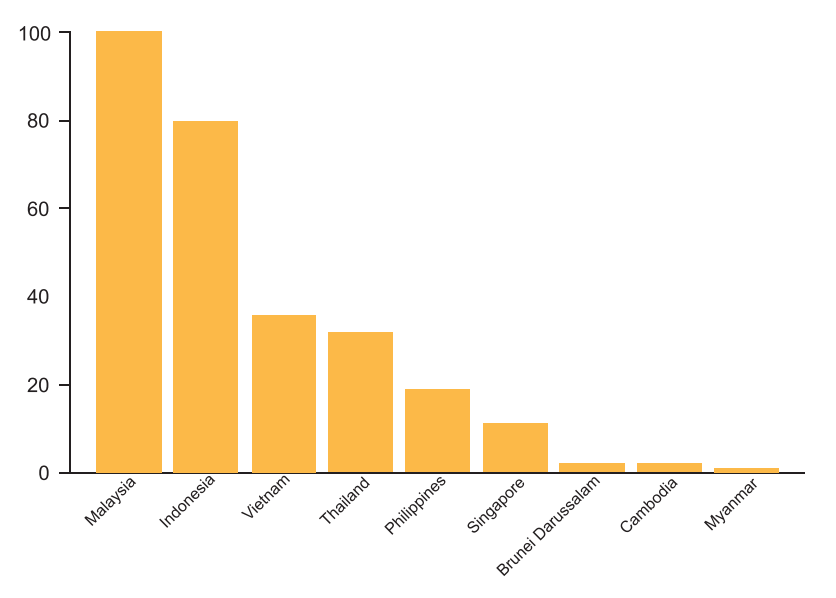
Number of reviewed studies per country
A systematic review of research on digital transformation in Southeast Asian countries from 2014 to 2023 reveals that approximately 35.5% of studies focused on the digital transformation of higher education in Malaysia, 28% on Indonesia, 12.5% on Vietnam, 11.5% on Thailand, 6.8% on the Philippines, 3.9% on Singapore, 0.7% on Brunei, 0.7% on Cambodia, and 0.4% on Myanmar. No research was found on Laos or East Timor. The majority of studies in the database were published between 2020 and 2023, indicating that the COVID-19 pandemic accelerated the region's digital transformation process to some extent.
Research has found that over the past decade, studies on the digital transformation of higher education in the region have primarily focused on two aspects: organizing digital culture and managing and applying digital knowledge. However, relatively little attention has been paid to the four dimensions of knowledge creation and innovation, knowledge development, knowledge exchange and collaboration, and digital and physical infrastructure. A systematic literature review indicates significant differences in the application of digital technologies among Southeast Asian countries. The adoption of digital technologies in higher education has brought not only numerous opportunities but also a series of challenges.
2. Opportunities Outweigh Challenges, But Weaknesses Remain Prominent
Overall, digital transformation presents more opportunities than challenges in almost all aspects. However, research on knowledge management and application indicates that challenges outweigh opportunities in higher education institutions in some countries, such as the Philippines, Laos, and Vietnam.
Regarding organizational digital culture, Southeast Asia faces key challenges, including a lack of agile cultural thinking to drive digital transformation and neglect of employee well-being. Key opportunities lie in the increased enthusiasm of teachers and students for learning digital technologies and the growing acceptance of blended learning models among students.
In knowledge creation and innovation, key challenges include a lack of digital vision among senior management and a weak research culture, particularly pronounced in less developed countries within the region. Empirical studies from Malaysia, Indonesia, and Thailand demonstrate that opportunities for knowledge creation and innovation are closely linked to strong government and higher education support.
In knowledge development, key challenges include insufficient professional development for teachers in digital technologies due to financial constraints and curriculum systems failing to adapt to the needs of the digital age. Opportunities lie in learners' ability to leverage various online tools to enhance learning outcomes and the smooth implementation of e-learning across multiple digital platforms.
In terms of knowledge management and application, the main challenges faced by higher education institutions in most Southeast Asian countries include a lack of effective data and information storage and management systems, a lack of ability to leverage business intelligence to optimize existing data and information, and a lack of strategic decisions to support digital knowledge management and application and accelerate digital transformation.
Regarding knowledge exchange and collaboration, higher education institutions in most Southeast Asian countries still face challenges. Digital communication, as an emerging skill, has not been adequately cultivated in basic education, resulting in many university students having little knowledge of digital etiquette and behavioral norms. The lack of collaboration between higher education and industry is considered a major obstacle to digital transformation.
In terms of digital and physical infrastructure, the biggest challenge faced by higher education institutions in most Southeast Asian countries is the significant gap between developed and developing countries, and between urban and rural areas. Laos and East Timor lag behind in the development of digital and physical infrastructure, significantly lagging behind the overall development level of the region.
3. Policies focus on infrastructure and innovation, while knowledge management and cultural development lag behind
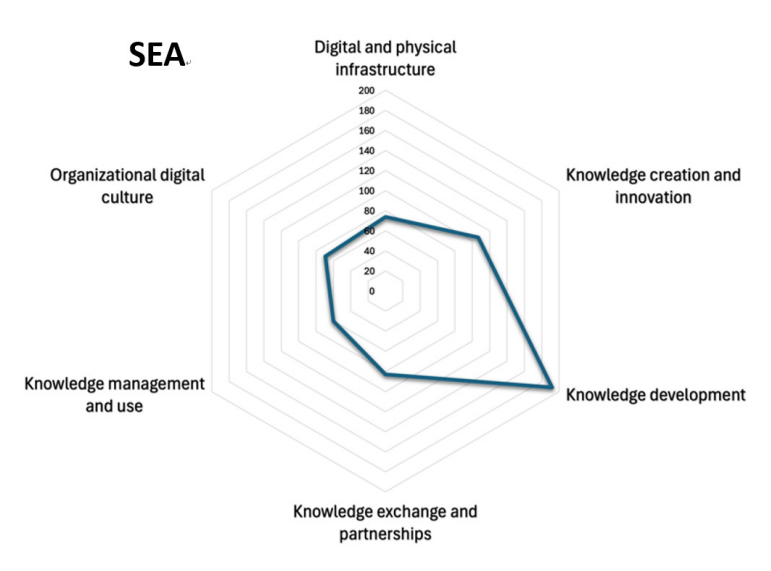
Radar chart depicting SEA's DTxHE policy focus areas
In the policy section, an in-depth study of 35 national policy documents concerning the digital transformation of higher education in Southeast Asia reveals that this transformation is increasingly guided by national and regional policy frameworks aimed at promoting the deep integration of digital technologies into teaching, learning, and administration.
A significant policy trend prioritizes knowledge development and innovation. Countries such as Vietnam and Cambodia have introduced policies to encourage higher education institutions to update their curricula and increase investment in digital infrastructure to better align with global standards. Despite some progress in digital innovation, many Southeast Asian countries still lack effective policies to comprehensively manage institutional knowledge and digital resources. While existing policies emphasize knowledge creation, there are shortcomings in establishing systems that can effectively capture, share, and utilize knowledge to enhance institutional capabilities.
The region's policy orientation also places great emphasis on infrastructure development. Governments are viewing digital infrastructure as a core pillar of education reform and are increasing investment. Countries such as Singapore, Malaysia, and East Timor have introduced policies to expand internet coverage, build digital learning centers, and upgrade information technology systems to create a more inclusive and technologically advanced educational environment.
One key policy focus is cultivating a digital organizational culture within higher education institutions. Southeast Asian governments emphasize the need for institutions to adapt their internal cultures to better align with innovation-driven and technologically advanced trends. Policies such as Malaysia's "Higher Education 4.0" and Indonesia's "Freedom of Learning" initiative reflect a policy orientation towards deeply integrating digital tools into daily teaching practices within the educational environment. However, at the policy framework level, the development of a digital organizational culture has not yet been fully realized. More robust policy measures are urgently needed to deeply integrate digital transformation into the core culture of educational institutions.
Regarding international cooperation, regional policies actively promote partnerships with global institutions to improve the quality of digital education. For example, Vietnam and Thailand have used policy tools to promote international teacher exchanges, research collaborations, and joint projects, which are crucial for the effective implementation of global best practices in digital transformation.
Digital equity and inclusion also face significant policy challenges. While countries like Singapore and Malaysia have made some progress in bridging the digital divide, many policies still fail to adequately address the needs of disadvantaged groups, especially students in remote or resource-poor areas. Therefore, policy intervention is urgently needed to improve digital accessibility and ensure that all students can equitably participate in the digitally transformed education system.
Country-Specific Practice Highlights: Innovative Examples of Differentiated Paths
Singapore: An Exemplar Case of a Successful DTxHE Case
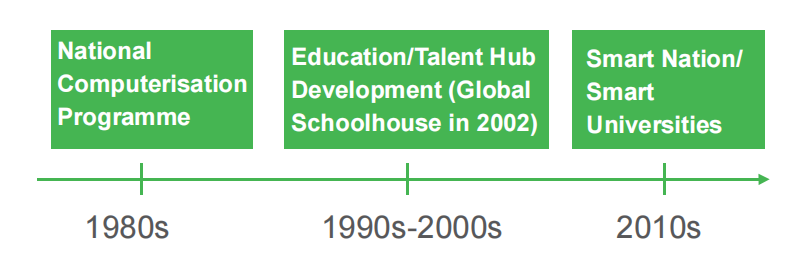
Singapore's journey of DT's showcase
Over the past four decades, Singapore has become one of the world's leading digital innovation nations, thanks to its outstanding digital transformation policies, continuous investment, and efficient implementation. Singapore has consistently invested heavily in building a robust digital infrastructure and a high-level talent development system, driving its vision of "Digital-Based, Service-Oriented" through the "Smart Nation Strategy" and the "Future Skills Upgrade Program."
Benefiting from the "Smart Nation" and "Smart University" policies of the past decade, the National University of Singapore (NUS), Nanyang Technological University (NTU), and Singapore Management University (SMU) have widely adopted AI systems to achieve personalized learning and administrative automation. For example, NTU's smart campus initiative has created a technology-driven learning environment by deploying IoT devices and digital infrastructure. In 2019, SMU partnered with Google Singapore to launch a data analytics course, marking the first time Google extended this course to undergraduate students at a local university. In 2020, NTU collaborated with Microsoft to shape the future of education through innovation and technology within the university's smart campus. Today, NUS, NTU, and SMU have joined the ranks of world-class universities, an achievement attributed to the government's precise digital transformation strategy implemented in the last century.
Cambodia: A Transparent and Well-Developed Policy Case
Cambodia, one of the least developed countries in Southeast Asia, faced a systemic disruption in its education system, which was subsequently restored with the support of international aid. Against this backdrop, Cambodia's path to digital transformation in higher education is undoubtedly longer and more challenging. Notably, the Cambodian government has demonstrated a strong commitment to digital transformation in recent years, driving the process through systematic policies. Apart from Singapore, Cambodia is one of the few countries in Southeast Asia to have achieved comprehensive and systematic development in digital policy formulation.
Cambodia launched its first "Digital, Media and Information Literacy Competency Framework," outlining eight core competencies and related behavioral knowledge that Cambodian digital citizens should possess to ensure the public can use technology wisely, responsibly, efficiently, and safely. Between 2019 and 2020, the Cambodian Ministry of Education, Youth and Sports implemented a capacity-building program aimed at providing trainers with modern teaching methods and technologies and enhancing their ICT skills. The program's goal is to raise Cambodia's education level to the average level in Southeast Asia, reduce illiteracy, and provide equal access to quality education for all.
Vietnam: Key Features of an Evolving DTxHE Landscape
Vietnam's development model for digital transformation in higher education reflects, to some extent, common characteristics of many developing countries in the region and globally: despite varying progress in policy implementation among universities, the government strives to strengthen overall policy coordination and consistency through a national digital transformation roadmap and inter-departmental collaborative projects.
Vietnamese higher education generally focuses more on digital and physical infrastructure development and knowledge creation, while paying relatively less attention to knowledge exchange and cooperation, organizing digital culture, knowledge creation and innovation, and knowledge management and application. A distinctive feature of the country's education system lies in the differences between private and public universities. Private universities typically possess greater operational flexibility and access to flexible funding channels, exhibiting greater flexibility and initiative in the digital transformation process, and demonstrating stronger confidence. Public institutions, however, lag behind in digital transformation due to limited funding and ongoing disputes over autonomy. Nevertheless, recent policy reforms are gradually granting public universities greater autonomy.
Furthermore, experts point out that Vietnamese universities currently use different and incompatible digital learning systems, including some self-developed systems. This could mean that, with the rapid development of the higher education market, competition among universities far outweighs cooperation. The lack of coordination in the digital transformation of higher education may weaken its ability to connect with the broader digital economy, thereby affecting graduates' adaptability to the changing demands of the labor market.
Strategic Pillars for the Future: Five Pathways to Accelerate Digital Transformation
The application and integration of GenAI in the digital transformation of higher education still largely depends on the research support, resource guarantees, and autonomous decision-making of universities. The academic community needs time to comprehensively evaluate the advantages and disadvantages of GenAI and its profound impact on the digital transformation of higher education. Furthermore, the use of GenAI involves a series of ethical issues, such as the legality of the data used to train GenAI and the academic integrity risks arising from its improper use in student assessments. These challenges are common to all countries. This report proposes the following five strategic pillars to help higher education institutions accelerate their digital transformation:
Strategic Pillar 1: Teacher Professional Development (TPD) – Enhancing Digital Skills and Digital Pedagogy
Objective: Develop a comprehensive digital literacy strategy that enhances critical thinking, creativity, digital ethical behaviors and capability in digital and GenAI-embedded pedagogies to facilitate effective digital learning environments among HE academics, staff and students.
Actions: offering mandatory digital literacy courses for all relevant personnel in higher education institutions, incorporating modules such as digital ethics, critical thinking, and innovative problem-solving into the curriculum; establishing interdisciplinary digital innovation labs to encourage students and scholars to collaborate digitally on projects; integrating digital ethics into all courses; establishing teacher-led peer learning groups to share digital teaching strategies and tools; and establishing a reward mechanism to recognize and promote teachers who innovatively use digital tools and methods in their teaching.
Strategic Pillar 2: Digital Equity and Inclusion
Objective: Ensure all university members have equitable access to digital resources and opportunities, particularly those from disadvantaged backgrounds.
Actions: Partner with technology companies to provide devices and internet access to students facing financial hardship; regularly hosting workshops on digital inclusion; and regularly evaluating digital equity initiatives to ensure they effectively meet the increasingly diverse needs of the student body.
Strategic Pillar 3: Digital Organizational Identity
Objective: Foster a strong DOI that aligns with the university's mission, the digital economy, and global digital trends.
Actions: regularly providing specialized training for faculty and students to guide them in effectively managing their personal digital footprint and cultivating a positive and professional online image; developing and implementing a standardized framework to assess the progress of digital transformation; and utilizing the university's digital platforms to showcase and promote international digital collaboration achievements, thereby supporting the university's internationalization process.
Strategic Pillar 4: Digital Well-being
Objective: Integrate digital well-being into the university's wellness programmes to manage the impacts of digital usage.
Actions: developing relevant policies to encourage faculty and students to regularly disconnect from digital devices; launching special projects focusing on preventing technology addiction, managing online stress, and coping strategies against cyberbullying; and deeply integrating digital health resources into the existing student support system, making it an integral part of the overall health management framework.
Strategic Pillar 5: Digital Change Management
Objective: Equip staff and students to adapt to and benefit from emerging digital technologies and trends, including GenAI.
Actions: establishing a dedicated committee to continuously analyze emerging digital technologies such as GenAI and other digital trends, and assess their potential impact; developing comprehensive and systematic strategies to identify and mitigate risks associated with digital transformation, with a particular focus on key areas such as cybersecurity and privacy protection; and fostering a campus culture that values adaptability, continuous learning, collaborative innovation, open communication, and the willingness to explore new technologies.
About the Authors
This report is rooted in a joint research initiative between the UNESCO Regional Office in Bangkok and the International Centre for Higher Education Innovation under the auspices of UNESCO (UNESCO-ICHEI).
As a key agency for education coordination in the Asia-Pacific region, the UNESCO Bangkok is committed to supporting evidence-based policy dialogue, enhancing institutional capacity, and promoting equitable and high-quality transformation in education within the framework of Sustainable Development Goal 4. This report was prepared by the UNESCO Bangkok within the framework of its work on coordinating Sustainable Development Goal 4 in the Asia-Pacific region and within the context of the higher education transformation agenda. It reflects UNESCO's commitment to supporting evidence-based policy dialogue, enhancing institutional capacity, and promoting equitable and high-quality digital transformation in higher education.