Regional Insights on Digital Transformation in Higher Education: Opportunities and Challenges for South Asia
The readiness of higher education institutions (HEIs) for digital transformation is a key factor determining their ability to effectively adapt to the integration of artificial intelligence (AI) into education. Since 2023, the International Centre for Higher Education Innovation under the auspices of UNESCO (UNESCO-ICHEI) has collaborated with UNESCO regional offices, category 1 institutes, regional and international organizations, and higher education research institutions to conduct joint research. This includes studies on the digital transformation of higher education across eleven sub‑regions of the Global South, as well as an examination of critical issues related to the integration of AI into higher education systems. This series of articles will review the findings of these reports, aiming to provide knowledge‑based guidance for all stakeholders in higher education as AI continues to reshape the educational landscape.
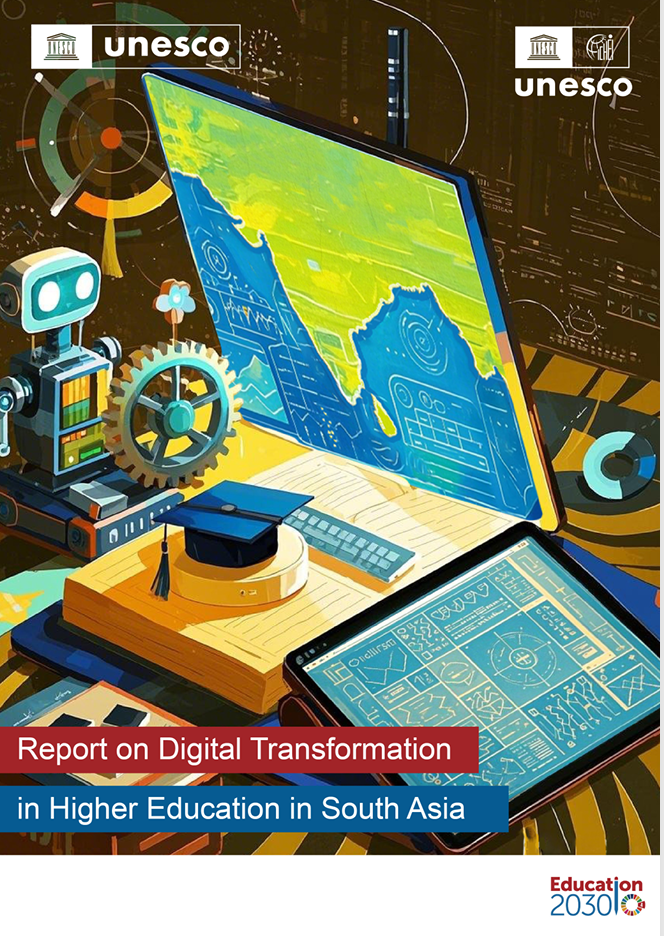
A joint study by UNESCO Regional Office in Bangkok and UNESCO-ICHEI takes a closer look at the state of digital transformation in higher education across six South Asian countries—Bhutan, India, the Maldives, Nepal, Pakistan, and Sri Lanka. It zooms in on the key challenges of integrating AI into higher education systems. Grounded in JISC's Framework for Digital Transformation in Higher Education, the findings are compiled in the Report on Digital Transformation in Higher Education in South Asia, offering a systematic review of the region's progress.
Research Findings
When we look into the South Asian region, the picture of digital transformation in higher education becomes far more complex. Here, bold national strategies exist alongside ground-level struggles. The following findings offer a clearer picture of where things stand—and where they're headed.
1. Behind the uneven progress, leadership makes the difference
Digital transformation across South Asia is unfolding at very different speeds. India has laid out a relatively comprehensive policy framework anchored by its National Education Policy 2020. Bhutan, though small, stands out for its strong national-level coordination and integration of digital efforts. In contrast, countries like Nepal and Sri Lanka are still catching up when it comes to turning policy into practice and scaling tech adoption. What explains the gap? A defining factor comes into focus: strong leadership and a clear strategic vision can often break through barriers more effectively than funding alone.
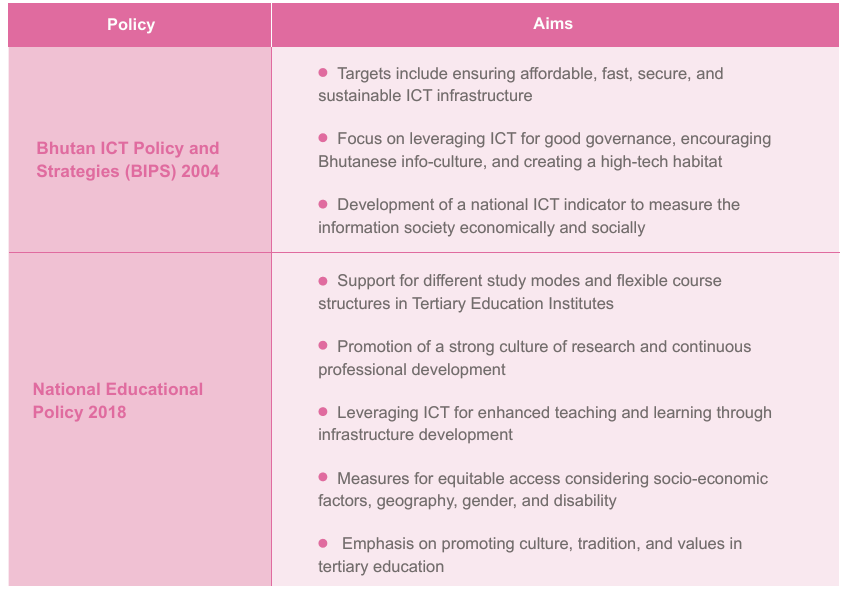
Policies that Stress ICT in Tertiary Education in Bhutan
2. Infrastructure: visible gaps and invisible barriers
The state of digital infrastructure across South Asia mirrors the region's development divides. India’s universities are trailblazing in network coverage and platform development, while in countries like Bhutan and Nepal, rugged terrain and limited resources mean simply getting campuses online remains a struggle. What stands out even more is the divide within borders—between cities and rural areas, between elite institutions and local colleges. The light of technology has yet to reach every classroom equally.
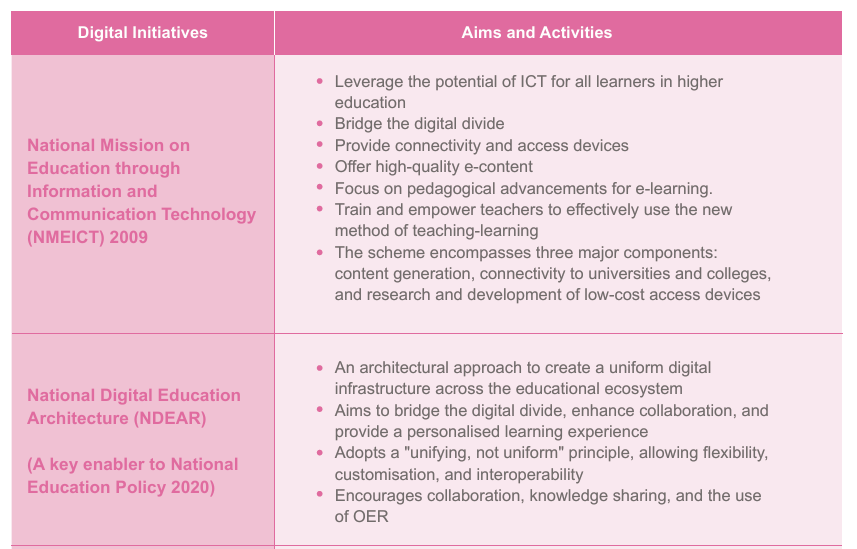
Key Digital Initiatives in India (Selected Examples)
3. Teachers: the most critical—and most vulnerable—players in the shift
The pandemic pushed countless teachers onto e-learning, ready or not. But once the emergency ended, a deeper issue came into sharper focus: the digital competence gap among educators—shaped by experience, institution type, and access to support—is far wider than we imagined. Some are already using AI tools to reshape their classrooms; others are still figuring out the basics of a live stream. That makes sustained, systematic professional development more urgent than ever. At the same time, teacher workload and mental health have rarely been more visible, or more in need of care.
4. Innovation: sparks are there, but still waiting to catch fire
AI, learning analytics, adaptive learning—these concepts have made their way into South Asia's higher education conversation, but systematic integration is still in its early days. A few Sri Lankan universities are experimenting with data to track student engagement in class, lighting up one corner of the innovation landscape. Across the region, however, most countries have yet to develop strategic roadmaps that align with global trends. Still, for the most part, technology is more of an add-on than a redesign.
5. Funding: a marathon, not a sprint
Digital transformation is never a one-off investment. From upgrading hardware to maintaining platforms, from training teachers to providing tech support—every step requires sustained funding. Yet most universities in South Asia still rely heavily on government allocations, with diversified, sustainable financing models yet to take shape. When short-term projects wind down and the spotlight moves on, whether transformation can go the distance depends largely on the resilience of the funding—and its ability to keep flowing.
Put together, these five findings paint a picture of a region at a crossroads—rich with opportunity, yet shaped by real constraints. They also put things in perspective: technology, after all, is just the tool. The real transformation, at the end of the day, is a long-term conversation about strategy, people, and resources.
Recommendations for the Road Ahead
Short-term (0–2 years): Start where it matters most
The most urgent task? Get teachers started with the tools. Targeted training programs need to roll out now—not generic tech talks, but real, usable skills: how to design a blended lesson, how to use AI for lesson prep, what teaching actually looks like in a digital age. When tech shifts from burden to boost, teacher confidence becomes the bedrock of transformation.
At the same time, universities should strengthen digital governance—setting up dedicated IT committees, adopting clear policies. Cybersecurity also needs attention: standard protocols, trained staff, multi-factor authentication. None of this can wait.
Equity has to be part of the picture too. Expanding access for underserved students—especially in rural areas—means device subsidies and low-cost internet plans. Because the digital divide should not become an opportunity divide.
Finally, let knowledge flow. Building regional networks—online platforms where teachers, researchers, and policymakers across South Asia can share what works—could be one of the smartest investments we make.
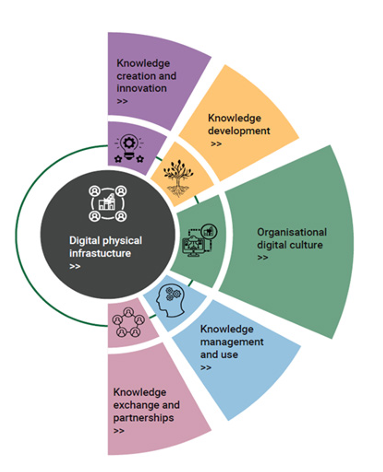
Theoretical Framework for Digital Transformation in Higher Education
Medium-term (3–5 years): Go deep, build systems that last
Once the foundations are in place, the next few years are about going deeper. Investing in what doesn't always get noticed, but makes everything else possible. High-speed broadband, cloud infrastructure, digital libraries, national learning repositories. These are the backbones that future innovations will rest on.
At the same time, universities and industry need to work closer together. Setting up tech incubation hubs on campuses can drive homegrown innovation—especially around ethical AI and equity-focused solutions. Because the big questions about AI ethics or fair access? They're not abstract—they need building on the ground.
Curriculum reform is another piece of the puzzle. Digital fluency—data literacy, coding, AI basics—should become part of every student's education, no matter their major. Think of it as the new liberal arts.
And then there's regional collaboration. A South Asia higher education digital alliance could open doors: credit transfers, joint research, cross-border exchanges. But for that to happen, credentials need to travel. That's where national frameworks for certifying online learning and digital credentials come in—something education ministries can lead on, making mobility real.
Long-term (6+ years): Looking forward, an ecosystem that sustains
Six years and beyond—this is about root-and-branch change. Building a sustainable ecosystem that's ready for the future.
First, funding has to evolve. A sustainable financing model is no longer optional—it's what keeps transformation alive when projects end and attention shifts.
Second, research needs a home. Setting up regional tech-enabled learning research centers—anchored by leading universities—could focus minds on what actually works: learning analytics, adaptive systems, AI tutoring, and the questions we haven't even asked yet.
Third, policy should catch up with ambition. A regional framework for digital education—common standards, mutual recognition of online degrees, coordinated research funding—would turn collaboration from idea into infrastructure.
Finally,decisions guided by data. Universities need to invest in platforms that don't just collect numbers but help ask better questions. What does meaningful analytics even look like? That's the conversation worth having.
This report is a 2025 collaboration between UNESCO Regional Office in Bangkok (UNESCO Bangkok) and UNESCO-ICHEI. Written by a team of experts at the Tata Institute of Social Sciences in India, it brings together insights from educators and policymakers across South Asia.
UNESCO Bangkok implements the six areas of UNESCO programmes—education, natural sciences, ocean sciences, social and human sciences, culture, and communication and information—in Afghanistan, Cambodia, Lao PDR, Myanmar, Singapore, Thailand, and Viet Nam. National activities are implemented by National Offices in Kabul, Phnom Penh and Ha Noi and an Antenna Office in Yangon. The Office has been leading the regional coordination and capacity development for the Education for All (1990–2000/2000–2015), and the SDG4-Education 2030 Agenda, covering 46 Member States and three Associate Members in the region, and within a network of 14 UNESCO Field Offices.