Insights on the Digital Transformation of Higher Education: Digital leap in East Asia
The readiness of higher education institutions(HEIs) for digital transformation is a key factor determining their ability to effectively adapt to the integration of artificial intelligence(AI) into education. Since 2023, the International Centre for Higher Education Innovation under the auspices of UNESCO (UNESCO-ICHEI) has collaborated with UNESCO regional offices, category 1 institutes, regional and international organizations, and higher education research institutions to conduct joint research. This includes studies on the digital transformation of higher education across eleven sub‑regions of the Global South, as well as an examination of critical issues related to the integration of AI into higher education systems. This series of articles will review the findings of these reports, aiming to provide knowledge‑based guidance for all stakeholders in higher education as AI continues to reshape the educational landscape.
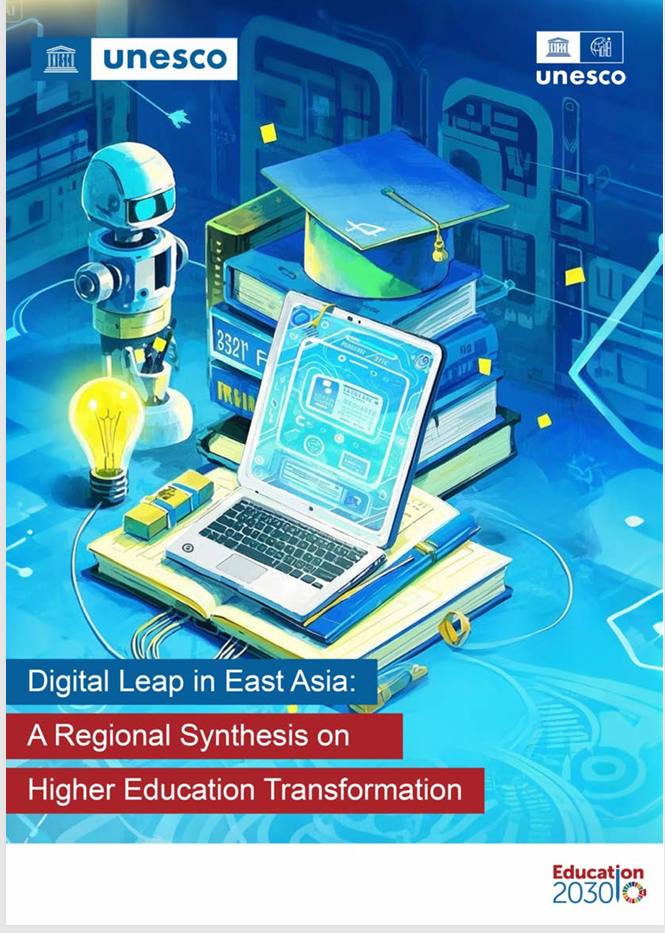
Digital transformation is leading higher education into a new era marked by both opportunities and challenges. East Asia, with its dynamic technological ecosystem, is at the forefront of this transformation. The report jointly produced by the UNESCO Beijing Office and UNESCO-ICHEI, titled Digital leap in East Asia: a regional synthesis on higher education transformation, systematically outlines the policies, practices, and challenges in the digital transformation of higher education in China, Japan, Mongolia, and the Republic of Korea.
East Asian Higher Education: Ecosystem and Challenges
The wave of digital transformation in education. From China, Japan, Mongolia to South Korea, diverse political structures, dynamic economic landscapes, and advanced technological capabilities together outline a uniquely multifaceted educational ecosystem here.
In recent years, countries in East Asia have achieved remarkable progress in expanding access to higher education. South Korea’s gross enrollment rate reached 96.4% in 2022, while Mongolia achieved a coverage rate of 71.5% (2022). Japan and China recorded rates of 59.6% (2021) and 64.6% (2022), respectively. Behind these figures lie the strides of countless families and students toward broader futures.
However, beneath the surface of prosperity, pressing challenges in higher education persist. Japan and South Korea, for instance, face increasingly pronounced demographic declines, which are beginning to undermine the enrollment foundations of some universities—particularly those in remote regions, where operational pressures are quietly mounting. Another widespread issue is the persistent mismatch between the skills many graduates possess and the actual demands of the labor market. Youth unemployment reflects the gap between the education system and the job market.
Furthermore, the issue of educational equity continues to linger—the resource gap between urban and rural areas, as well as disparities in allocation between public and private institutions, subtly deepen socioeconomic divides. Financial pressures, quality assurance in the process of internationalization, and the inertia of traditional teaching models also constrain, to varying degrees, the sustainable development of higher education.
Despite the challenges, the direction is clear. Countries in East Asia are all turning their gaze toward the same future: digital transformation. By expanding the reach of online education, optimizing resource allocation, and improving teaching quality, East Asia is striving to build a more inclusive and adaptable higher education system—allowing the light of education to reach more corners and paving a broader path for the future.
Policy Leadership: National Digital Strategy Framework
The digital transformation of higher education in East Asia relies on clear and robust policy leadership. Countries in the region established national-level digital strategies as blueprints to lay a foundation for the future of education. These strategies not only outline pathways for transformation but also emphasize ensuring that technological innovation genuinely serves socioeconomic development, allowing educational reform to resonate with social progress.
In China, the dual drivers of the "Digital China" strategy and the "Education Informatization 2.0" action plan emphasize strengthening digital infrastructure and promoting the deep integration of artificial intelligence with education. The goal is to advance educational modernization and broader educational equity. Turning to Japan, its vision of a "Society 5.0: Super Smart Society" places digital transformation at the core of societal development. Through the "GIGA School Program," Japan aims to equip all students with digital devices, making personalized learning accessible. South Korea, via its "Digital New Deal" and AI Education Alliance, focuses on cultivating talent for the digital era. It actively builds bridges for collaboration between universities and industries. In Mongolia, the "E-Mongolia" plan and the long-term "Vision 2050" initiative are dedicated to narrowing the urban-rural digital divide. By leveraging open educational resources, the country strives to enable students in remote areas to access quality education.
These top‑level designs are not castles in the air—they are supported by corresponding implementation mechanisms. Whether it is China’s centralized coordination, Japan’s decentralized collaboration, or South Korea’s ministry‑led model, all strive to ensure effective resource allocation and unified standards. Moreover, vibrant public‑private partnerships and regional cooperation networks—such as the ASEAN Plus Three (China, Japan, and South Korea) cooperation mechanism—are injecting further dynamism into these policies. Through shared funding and technological exchange, the digital transformation of higher education is becoming more closely integrated into the grand narrative of national development, collectively pointing toward a smarter and more inclusive future.
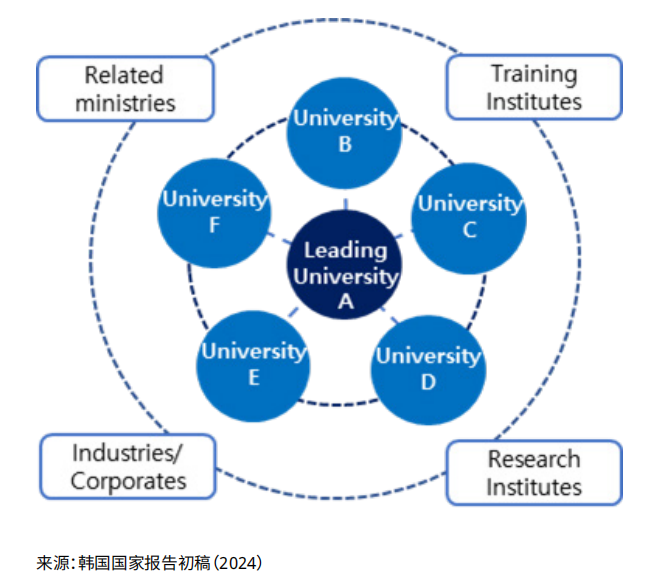
Conceptual Framework of the Korean Convergence and Open Sharing System Project
Current Status of Digital Transformation in Higher Education
Walking into university campuses across East Asia, traces of digital transformation have quietly permeated every corner—from the cloud to the classroom, from administration to experience. A quiet yet profound transformation is taking root here. Countries are building a rich, interconnected digital education ecosystem, each following its own distinctive path.
High-speed networks are the foundation of it all. Chinese universities are rapidly rolling out 5G networks, Japan is ensuring every classroom has stable Wi-Fi through the GIGA School Program, South Korea continues to upgrade with its world-leading broadband infrastructure, and Mongolia is steadily extending network access to its vast rural areas. Connectivity, first and foremost, is erasing distance.
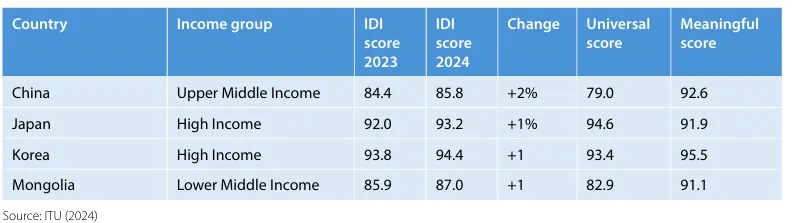
ICT Development Index by Country
Learning management systems have become the core stage of teaching. In China, platforms range from internationally used Moodle to localized ones like Beijing Normal University’s "ChangKe." Korea's Yonsei University integrates cloud storage and personalized learning through "LearnUs." Japanese universities, catching up at a remarkable pace, are accelerating the adoption of digital teaching tools. Mongolia, on the other hand, flexibly utilizes Microsoft Teams and Google Classroom to support its adaptive hybrid teaching models. Between screens, knowledge flows freely.
In the background, data centers and big data analytics quietly underpin scientific innovation and campus governance. From Peking University's "Weiming-1" high-performance computing center to the Mongolian University of Science and Technology’s UNIMIS system—these invisible "intelligent minds" empower teaching and management by turning data into actionable insights.
Stepping into today's "smart campuses," technology is deeply integrated into the learning experience. Beijing Normal University's holographic interactive smart classrooms and immersive blended online-offline classes make abstract knowledge tangible and experiential. Seoul National University's VR studio can simulate extreme environments, enhancing the authenticity of practical teaching. Meanwhile, the Education University of Hong Kong's AI education laboratory fosters students’ critical thinking through a self-developed large language model chatbot—here, technology serves to inspire, not to replace human agency.
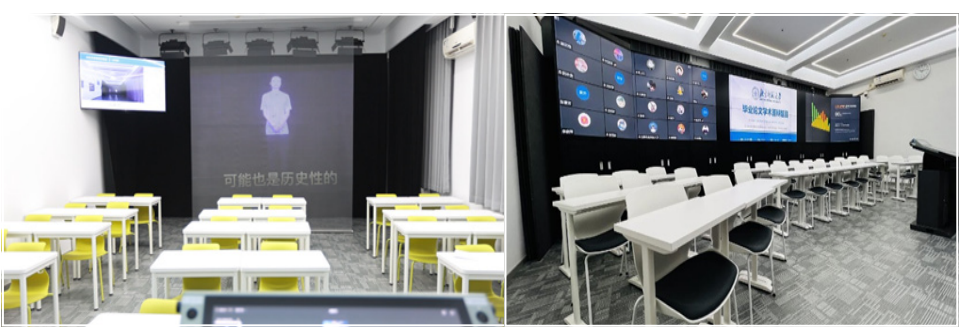
Beijing Normal University's holographic interactive smart classroom (left) and immersive online-offline hybrid teaching smart classroom (right)
Moreover, the widespread adoption of MOOCs platforms such as China's "XuetangX" and Korea's K‑MOOC has dismantled campus barriers. Simultaneously, blockchain technology brings credibility and convenience to credential verification. Together, they propel higher education toward a more flexible, efficient, and open future. The digital ecosystem transcends mere tool upgrades—it is reshaping the very nature of learning itself.
Digital Literacy of Educators and Students: The Core of Transformation
In the wave of educational digital transformation, what truly determines whether the transformation can be implemented effectively lies with the "people" in front of the screens—whether teachers and students possess the corresponding digital capabilities. This is not just about technical proficiency but a comprehensive competency that integrates thinking, ethics, and innovation. In East Asia, countries are striving to equip educators and learners with "digital wings" for the future through systematic frameworks and training programs.
Globally, frameworks such as UNESCO's Digital Literacy Competence Framework and the European Union's Digital Competence Framework provide essential references for regions. Yet, within actual classrooms, each country faces its own unique realities.
For teachers, the journey from "knowing how to use" to "knowing how to leverage effectively" remains a long one. China has introduced a comprehensive Teacher Digital Literacy Standard, covering areas from digital awareness to technical application. However, the ability to deeply integrate technology into curriculum design in actual teaching practice still needs strengthening. In Japan, although most teachers have received ICT training, only about 28% feel "well-prepared," highlighting the gap between training and real classroom demands. In Mongolia, nearly all educators use laptops, but the application of complex digital tools remains uncommon. Meanwhile, South Korea has chosen to focus on the forefront, cultivating teachers' AI-based teaching capabilities through initiatives like the AI Education Alliance, and directly linking digital literacy to professional development to motivate continuous growth.
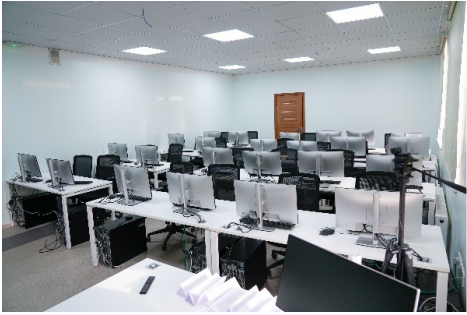
Cybersecurity Laboratory in Mongolia
On the student front, the younger generation—often called "digital natives"—seems inherently comfortable with technology. China has integrated digital skills into its basic education curriculum, while South Korean students skillfully navigate various online learning platforms. In Japan, however, students’ ability to discern information and their ethical awareness in digital spaces still require strengthening. In Mongolia, although students self‑rate their digital competence highly, their actual participation in in‑depth learning activities like MOOCs remains relatively low, indicating a need for more guidance and support.
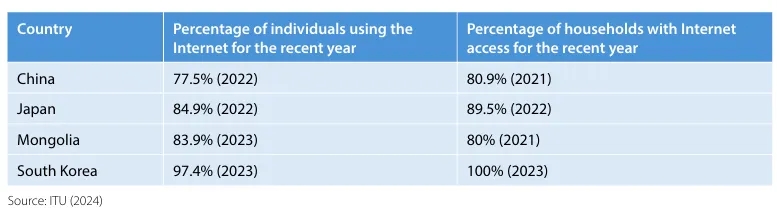
Individual Internet Usage Rate and Household Internet Access Rate by Country
Challenges remain clear: disparities in capability caused by the digital divide, uneven distribution of resources between urban and rural schools, and weak ethical awareness in technology application… These issues remind us that transformation must not stop at infrastructure. For this reason, countries are working to narrow the gaps through specialized workshops, systematic online courses, and industry‑education collaboration projects. The goal is to ensure that every teacher and student not only has access to technology but can also use it effectively, unlocking the potential for pedagogical innovation and truly personalized learning.
Highlights of Country‑Specific Practices
The digital transformation of higher education in East Asia is being explored and practiced by every university, teacher, and student in real-world contexts. Across East Asian nations, vibrant and uniquely innovative landscapes are unfolding.
China's breakthroughs in the MOOC (Massive Open Online Courses) sector have been particularly remarkable. Platforms like "XuetangX" have cumulatively offered tens of thousands of courses, with the number of learners exceeding 540 million. Driven by policies such as the "Double First-Class" initiative, MOOCs are gradually being integrated into the credit systems of universities, attempting to bridge the path from "online" to "on-campus" learning. Despite challenges such as varying course quality and low completion rates, the scale and model of China's MOOC efforts have already provided the world with a scalable example of digital education.
Turning our gaze to Kagawa University in Japan, a bottom‑up transformation is underway. Centered on the "Digital ONE" strategy, the university has integrated multi‑campus management through agile development and no‑code tools, enhancing operational efficiency. Even more noteworthy is its establishment of the "Digital Transformation Laboratory"—where students are no longer merely users of technology but active participants in solving real‑life community problems with digital tools. This "learning by doing" model allows the transformation to truly take root within the campus ecosystem.
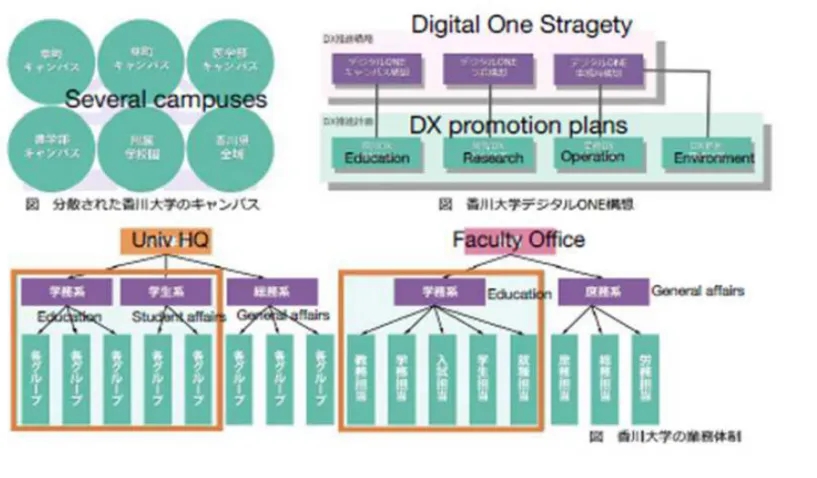
Digital One Strategy of Kagawa University
South Korea, on the other hand, has focused on "igniting the power of teachers." Through initiatives like the AI Education Alliance and policy labs, the country is systematically building the Teacher AI and Digital Competency Frameworkand deeply integrating AI tools into pre‑service training. Its goal is clear and forward‑looking: not to replace teachers with technology, but to drive a "teacher‑led classroom revolution."
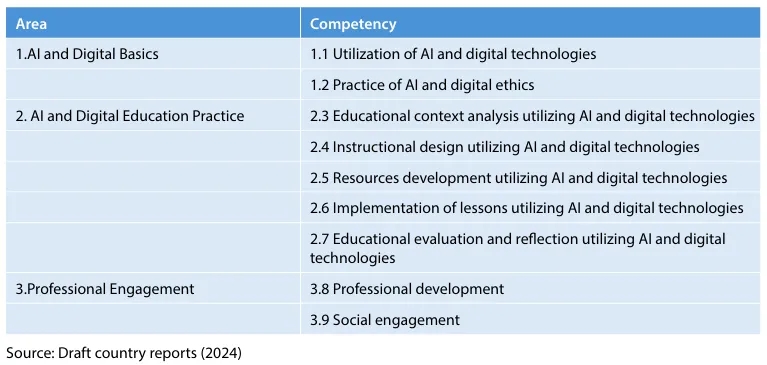
Teacher AI and Digital Competency Framework
In Mongolia, where resources and geographic conditions present challenges, the path to transformation reflects pragmatism and resilience. Anchored by the national "E‑Mongolia" initiative, universities such as the Mongolian University of Science and Technology have independently developed online learning systems like UNILIS and are actively exploring the application of blockchain in credential verification. Although infrastructure in rural areas remains a gap, through sustained international cooperation and local innovation, educational inclusivity is steadily advancing, step by step.

Screenshot of the virtual assistant "Andaa" interface developed by the National University of Mongolia
Behind these vivid practices lies the integration of policy, technology, and localized wisdom. Their paths may differ, yet they collectively reveal a truth: authentic digital transformation remains fundamentally about the transformation of people—between screens and lines of code, the warmth and depth of education remain palpably present.
From the practices of East Asian countries, we can discern a clear path—by building a systematic support system can we truly drive the deep transformation of education in the AI era. As AItechnologies continue to profoundly reshape higher education, these concrete approaches remain key to enhancing the overall capabilities of higher education institutions:
Policy and Governance
Elevate digital transformation to a strategic level that drives socioeconomic development, establishing clear national guidelines and implementation roadmaps. The key is to create a well‑defined, multi‑level governance framework for data and cybersecurity, ensuring a compliant, secure, and innovative foundation for the use of educational data.
Digital Infrastructure
The priority is to ensure equitable and affordable access to high‑speed internet and essential digital devices for all teachers and students. Public investment in and promotion of high‑quality, localized open educational resources (OER) should be increased to fundamentally narrow the digital divide caused by geographic and economic disparities.
Digital Capacity Building
Provide teachers with continuous, systematic, and practice‑oriented training in digital skills, while deeply integrating critical thinking, digital literacy, and AI literacy into student curricula. Incentive mechanisms should also be established to encourage frontline educators to actively participate in the design, piloting, and feedback of AI‑powered educational tools, ensuring that technology truly meets teaching needs.
Pedagogy and Assessment
Advocate for an education‑first, ethics‑driven approach to integrating AI throughout the teaching and learning process, using learning analytics to provide personalized support for every student. This requires investing in building or upgrading advanced, user‑friendly learning management systems (LMS) as core platforms for teaching innovation and scientific assessment.
Digital Collaboration
Digital transformation cannot be achieved by any single institution alone. It necessitates fostering stable partnerships among governments, universities, private tech enterprises, and international organizations. Through collaborative platform development, resource sharing, joint research, and exchanging best practices, cross‑sector synergy can accelerate the incubation and scaling of innovative solutions.
About the Authors
This collaborative research on the digital transformation of higher education was conducted by the International Institute for Higher Education Regional Office for East Asia and the International Centre for Higher Education Innovation (UNESCO-ICHEI).
The UNESCO Regional Office for East Asia was established in 1984 and is responsible for projects and work in five East Asian countries: the Democratic People’s Republic of Korea, Japan, Mongolia, China, and the Republic of Korea. The office is committed to identifying and implementing innovative solutions for sustainable development in social, cultural, environmental, and economic dimensions, helping countries achieve their national development priorities and fulfill their commitments to the Sustainable Development Goals and the 2030 Education Agenda.