UNESCO-ICHEI Attended Southeast Asia Seminar on Micro-Credential Policies, Joining Discussions on the Regional Framework
Marking the fifth anniversary of the Indonesia Cyber Education Institute (ICE Institute), the Indonesia National Centre of the International Institute of Online Education (IIOE), the Southeast Asia regional seminar "Towards a Regional Framework for Micro-Credential Policies" was held in Jakarta, Indonesia, on 16 September 2026. The International Centre for Higher Education Innovation under the auspices of UNESCO (UNESCO-ICHEI) attended by invitation and delivered a keynote speech, sharing experience in the development and certification of micro-credential courses, both in Chinese industry and at UNESCO-ICHEI itself, and taking an active part in policy discussions on micro-credential development in Southeast Asia.
The Southeast Asia regional seminar "Towards a Regional Framework for Micro-Credential Policies"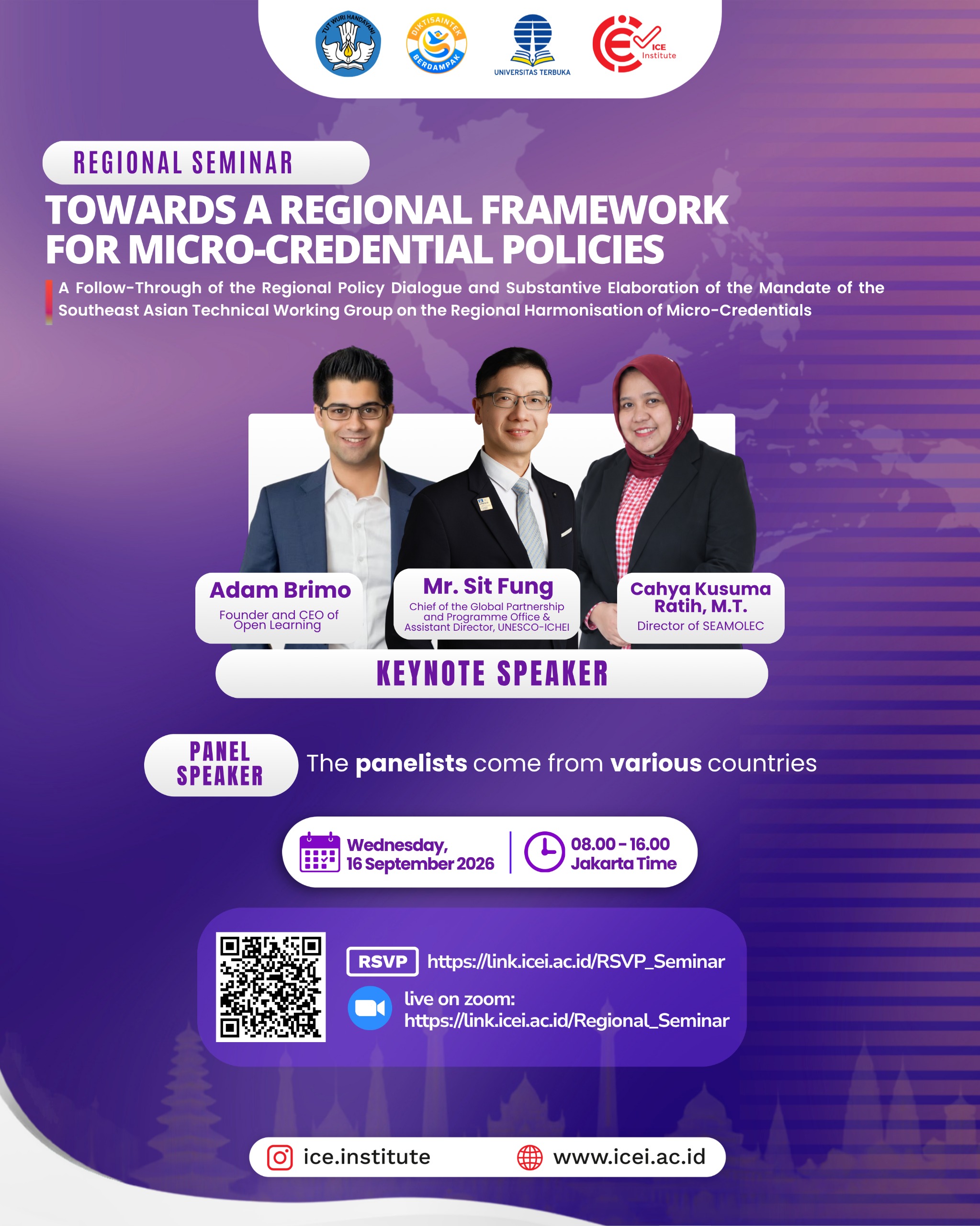
The Seminar was organised by the ICE Institute, with the Southeast Asian Ministers of Education Organization Regional Open Learning Centre (SEAMOLEC), UNESCO-ICHEI, Universitas Terbuka and members of the ICE Institute Consortium taking part as partners. Building on the outcomes of the Regional Policy Dialogue on Harmonising Micro-credentials in Higher Education, held in Jakarta from 7 to 9 June 2026, the Seminar was designed to gather input for the first working sessions of the Southeast Asian Technical Working Group on the Regional Harmonisation of Micro-Credentials.
Participants at the Seminar
Prof. Rahmat Budiman, Vice Rector for Academic and Student Affairs of Universitas Terbuka, delivered the welcoming remarks and formally opened the Seminar. He expressed his sincere appreciation for the important role played by SEAMOLEC, UNESCO-ICHEI and the ICE Institute in the Seminar. He noted that micro-credentials have become one of the most talked-about ideas in higher education in Southeast Asia, and that partners across the region should build consensus and set a shared direction for development through honest and open exchange.
Prof. Rahmat Budiman, Vice Rector for Academic and Student Affairs of Universitas Terbuka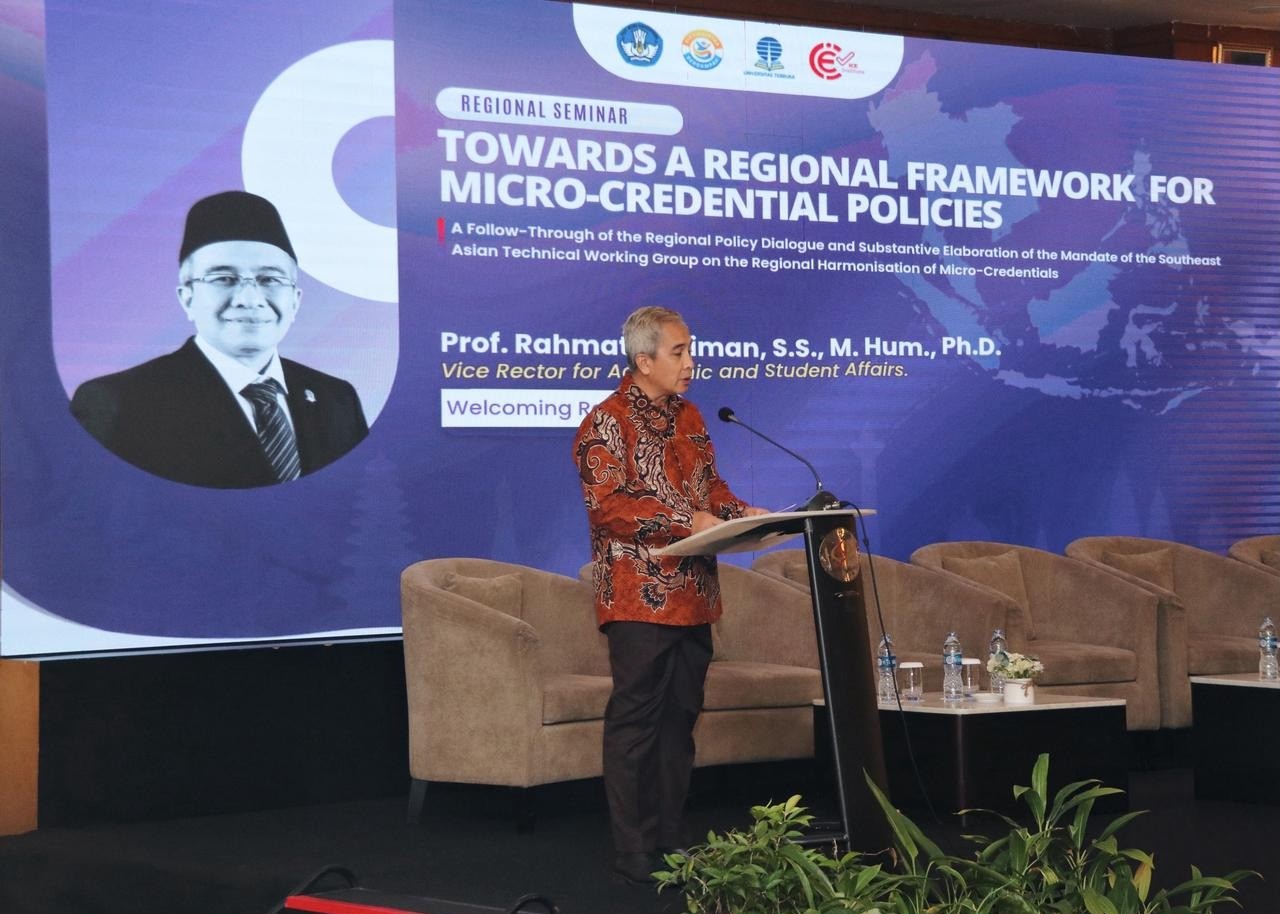
Mr. SIT Fung, Assistant Director & Chief of the Global Partnership and Programme Office, UNESCO-ICHEI, delivered the keynote speech on "Global Practices and Lessons in the Recognition of Micro-Credentials in Industry-University Collaboration". He noted that, against the background of deepening industry-education integration, China has explored a pathway in industry certification — exemplified by the 1+X Certificate System, in which the "1" is the academic qualification and the "X" a number of vocational skill-level certificates — transforming talent needs in emerging industries into competencies that can be learned, assessed and certified, and developing talent at scale. By connecting academic education with vocational skill-level certification, the 1+X programme provides important practical experience, grounded in a national context, for the development of micro-credentials. In June this year, UNESCO-ICHEI successively launched the IIOE "AI+Industry" micro-certification programmes, comprising the "AI+Life Sciences" courses, developed jointly with BGI Group; the "AI+Agritechnology" courses, developed jointly with the IIOE Malaysia National Centre, Universiti Putra Malaysia; and the "AI+Cross-Border E-Commerce" courses, developed in partnership with the China Association of Trade in Services (CATIS). The courses are now available on the IIOE platform, and pilots have been launched in Malaysia and Uzbekistan, with the IIOE National Centres responsible for localising the content and carrying out implementation.
Mr. SIT Fung, Assistant Director & Chief of the Global Partnership and Programme Office, UNESCO-ICHEI, delivered the Keynote Speech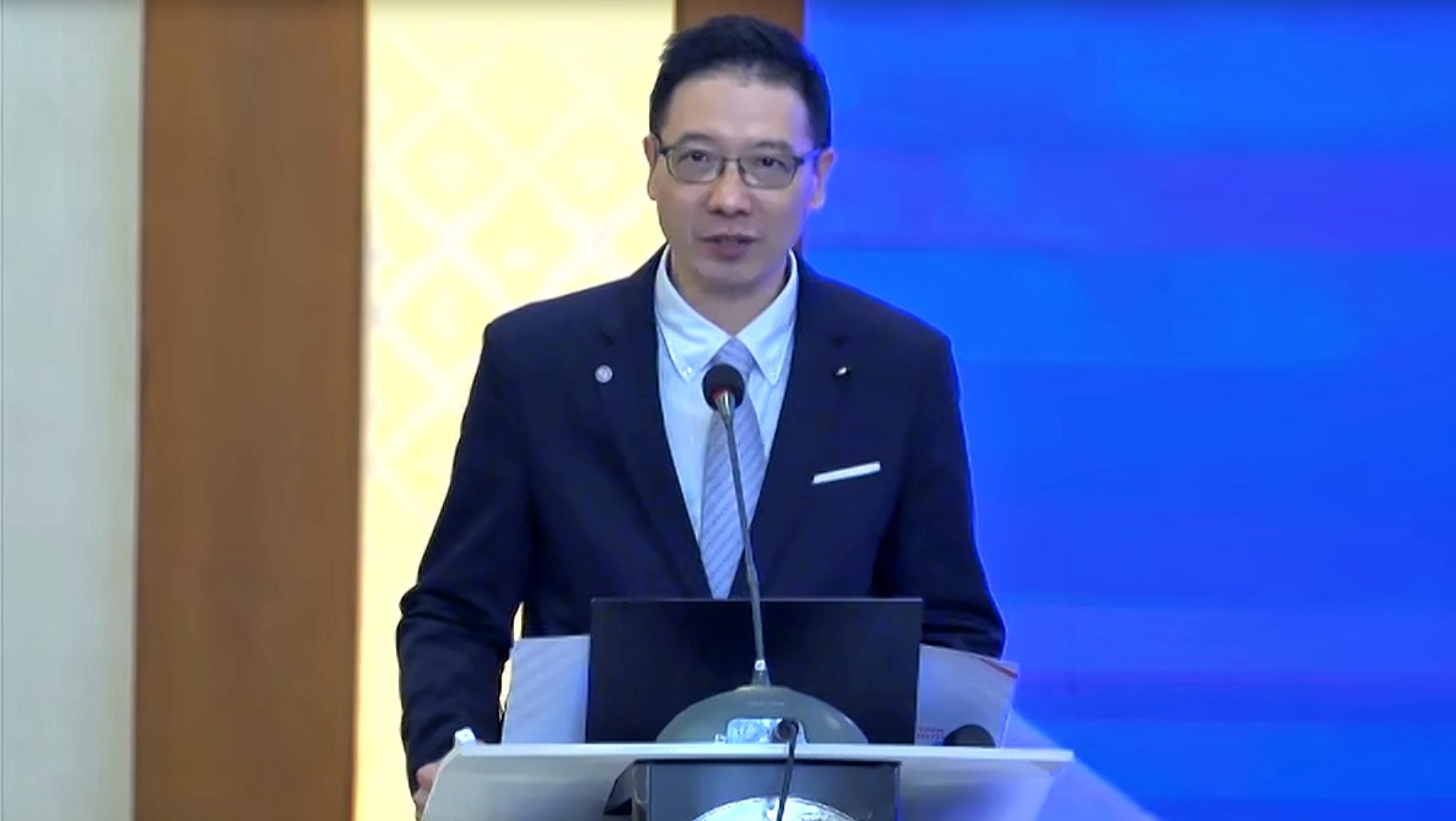
In the panel discussion on "Industry's Recognition of Microcredentials", Mr. ZHANG Boyi, Programme Officer of the Global Partnership and Programme Office, UNESCO-ICHEI, exchanged views with industry and policy representatives from Viet Nam and Indonesia. He observed that the greatest disconnect between universities and industry is a lack of trust, and that enterprises should take part in co-developing courses from the concept design stage onwards. He introduced that, over several years, the IIOE platform has grown into a global ecosystem connecting higher education institutions and industry partners. IIOE develops standard courses designed for global use, which partner institutions then adapt to their own countries' industry and talent needs - a model that can serve as a reference for Southeast Asia. In June this year, UNESCO-ICHEI and the Secretariat of the Southeast Asian Ministers of Education Organization (SEAMEO) jointly inaugurated the IIOE Southeast Asia Regional Centre; building on the Regional Centre, the IIOE Southeast Asia task force will be convened to bring together the IIOE National Centres and draw more enterprises and industry associations into the work, creating a partner ecosystem that is jointly built and shared.
Mr. ZHANG Boyi, Programme Officer of the Global Partnership and Programme Office, UNESCO-ICHEI, spoke at the panel on "Industry's Recognition of Microcredentials"
During the Seminar, at the invitation of the ICE Institute, UNESCO-ICHEI submitted Recommendation Papers on regional micro-credential development. Looking ahead, micro-credentials should begin with clearly defined learning outcomes and competencies; industry should be involved meaningfully across the whole cycle, from competency identification and course development through to employability support; and stronger bridges should be built between micro-credentials, degree programmes, occupational qualifications and credit recognition, so that stackable pathways for lifelong learning can emerge. UNESCO-ICHEI proposes localisation based on a common framework plus local content, local assessment and local industry engagement, with gender equality as a cross-cutting quality principle and with provision deliberately reaching working professionals, micro-entrepreneurs and marginalised groups; the IIOE National Centres and the IIOE Southeast Asia Regional Centre would support the sharing of courses and learning resources, strengthen the capacity of faculty members, and support pilot programmes across multiple countries. Looking ahead, UNESCO-ICHEI will continue to work with the ICE Institute and partners across Southeast Asia to help make micro-credentials a record of demonstrated competence that connects learning with employment and is recognised by multiple stakeholders.