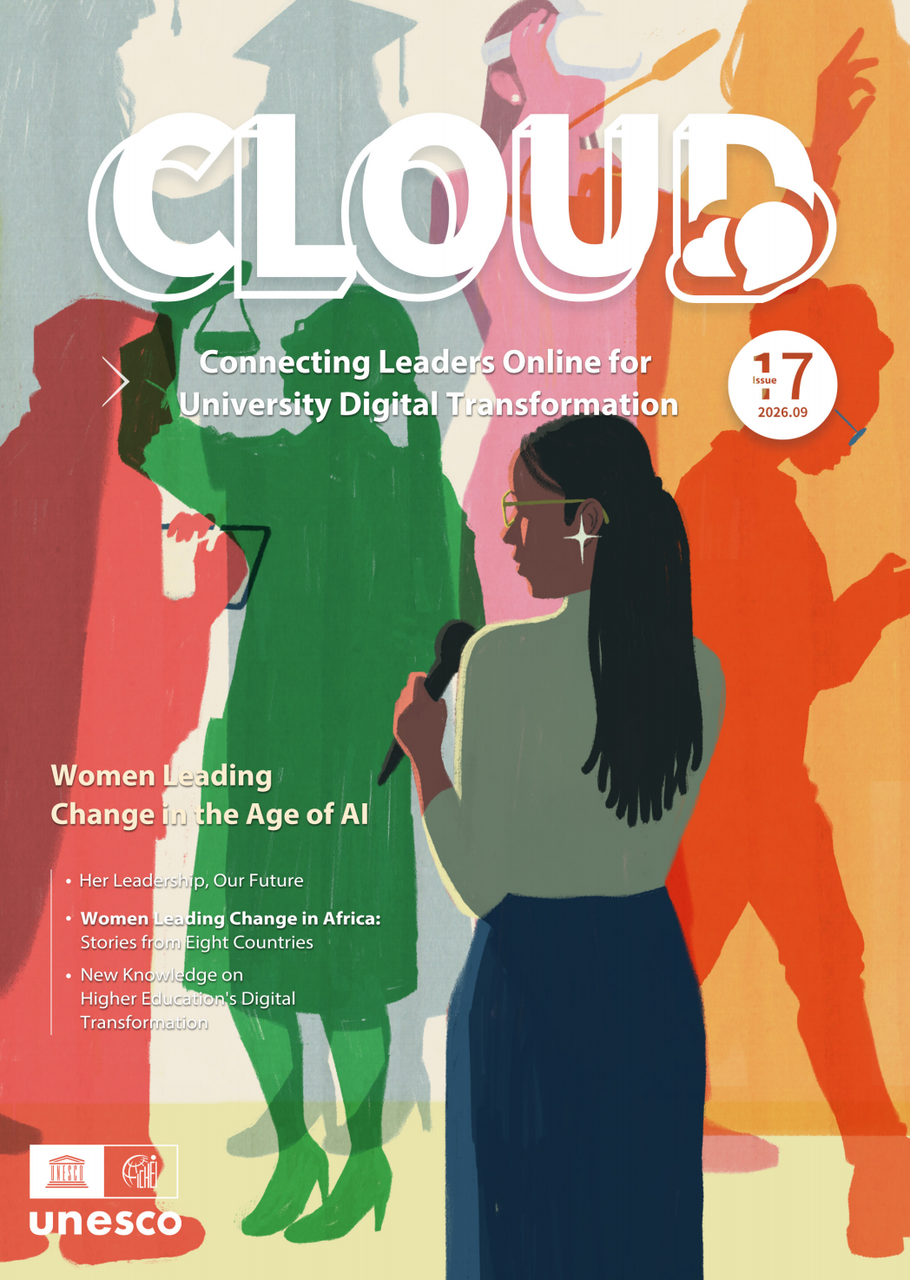
CLOUD Issue 17 Officially Released | Women Leading Change in the Age of AI
Recently, we reflected on the thinking behind the Women Leading Change in Africa (WLCA) project and traced its progress to date (see previous post). This issue of CLOUD continues that conversation, turning to practical cases of the project's implementation by UNESCO IITE, UNESCO-ICHEI and African partner higher education institutions: how does change take shape, and how does it unfold across institutions? How are women building their AI literacy, joining learning communities, and carrying new knowledge and skills into research, management and policy discussions? From access to action, from participation to leadership and public recognition, their journeys are what this issue sets out to capture: a gender-inclusive AI transformation in higher education.
Click here to explore
Expert Insights
Ms. Shafika Isaacs, Director a.i. of UNESCO Institute for Information Technologies in Education (UNESCO IITE) and Chief of Section for Technology and AI in Education at UNESCO Headquarters, observes that the AI divide is primarily a gender divide. In the worlds portrayed by AI, including emerging agentic systems, women are more often cast as assistants and caregivers than as leaders or drivers of change. Awareness raising and actions needs to be taken from leadership development to competency development.
Long-Standing Commitment
The article Her Leadership, Our Future: Gender Perspectives in Higher Education's Digital Transformation looks back at how gender equality has been woven into UNESCO-ICHEI's work over the years, through project design and evaluation, platform building, curriculum development, policy dialogue and partnership. WLCA brings that long-standing commitment into sharper focus for the age of AI. Jointly launched by UNESCO-ICHEI and UNESCO IITE, it works through universities across Africa to build higher education professionals' digital and AI skills, turning that capability into practice, leadership, institutional support and new knowledge.
More Stories
Ain Shams University (Egypt)

At Ain Shams University, WLCA is connecting AI learning with practical application, women-led innovation, public recognition and academic progression. Online courses and micro-certifications are widening access for women, while initiatives such as the She Leads Award bring their achievements to public and international attention, encouraging new ideas and collaboration.
Addis Ababa University (Ethiopia)

Addis Ababa University's experience shows how online micro-certification, hands-on AI practice and institutional recognition can work together to support women academics professional growth. As one of the first institutions to integrate IIOE micro-certifications courses into its continuing professional development framework, it is creating long-term institutional support for women's career progression and leadership development.
Ahmadu Bello University (Nigeria)

At Ahmadu Bello University, a women-led team of the IIOE Nigeria National Centre is turning apprehension about AI into confidence, competence, and community; showing how leadership, learning communities, and hands-on training can widen women's participation in digital higher education.
Mulungushi University (Zambia)

Led by Mulungushi University through the IIOE Zambia National Centre, WLCA is developing into a nationwide network spanning universities and technical and vocational education institutions. By engaging educators, researchers, administrators and university leaders (not technical specialists alone), the network is enabling more women to participate in the AI transformation of higher education.
University of Cape Coast (Ghana)

In joining WLCA, University of Cape Coast hopes to help Ghana's women educators move from adapting to digital transformation toward shaping it, and build the AI skills and institutional support to ease the barriers that have long held them back.
Makerere University (Uganda)

Makerere University is extending its long-standing work on gender mainstreaming into new areas. By strengthening its partnership with IIOE and implementing the WLCA project, the university aims to help more women take their place at the heart of the AI era.
Articles from CLOUD will be published over the coming weeks on UNESCO-ICHEI's website and social media channels; in the meantime, explore previous issues and join the conversation: https://en.ichei.org/en/knowledge/yunji/.
Thank you for your continued support of CLOUD. We hope this issue will prove both informative and inspiring, and look forward to working together in fostering a more open and inclusive higher education landscape in the era of AI.
About CLOUD
CLOUD is an original quarterly magazine guided by UNESCO-ICHEI's mission to advance the digital transformation of higher education in developing countries. It presents a multi-perspective view of global developments and innovative practices, from digital transformation strategies to exemplary institutional cases, offering a visually engaging and accessible resource for higher-education innovation. "CLOUD" symbolises "connecting leaders online for university digital transformation". Published both in print and online, it provides an open, inclusive platform for information exchange among higher-education practitioners worldwide. As a two-way window linking Shenzhen with the world, the magazine is available in all six official languages of the United Nations.