"AI+Cross-Border E-Commerce" Micro-Certification Programme Now Available on IIOE
Digital technologies continue to reshape the organisation of international trade. Cross-border e-commerce has evolved from a relatively single form of platform-based transaction into a comprehensive business system encompassing market analysis, product development, supply chains, logistics, payments and settlement, digital marketing, and compliance governance. The growing application of artificial intelligence(AI) is further transforming product selection, content creation, operational analysis, multilingual services, and customer communication, creating new demands for the knowledge and practical competencies of cross-border e-commerce talent.
The "AI+Cross-Border E-Commerce" Micro-Certification Programme is jointly advanced by the UNESCO International Centre for Higher Education Innovation (China, Shenzhen) (UNESCO-ICHEI) and the China Association of Trade in Services (CATIS) through the International Institute of Online Education (IIOE) platform. The Programme was officially launched on 6 June 2026 during the Global Future Higher Education Summit: A New Ecosystem for AI-Driven Industry-Academia Collaborative Talent Development. The two organisations brought together industry experts, university teachers, and business practitioners to conduct course research, framework design, content development, and quality review in response to cross-border e-commerce talent development needs, transforming industry knowledge, educational experience, and real-world cases into resources suitable for online learning.
Access the "AI+Cross-Border E-Commerce" section at:
https://www.iioe.org/#/news/detail/dfeadb57-13cd-4953-82f1-f945b9bb1ac0/0
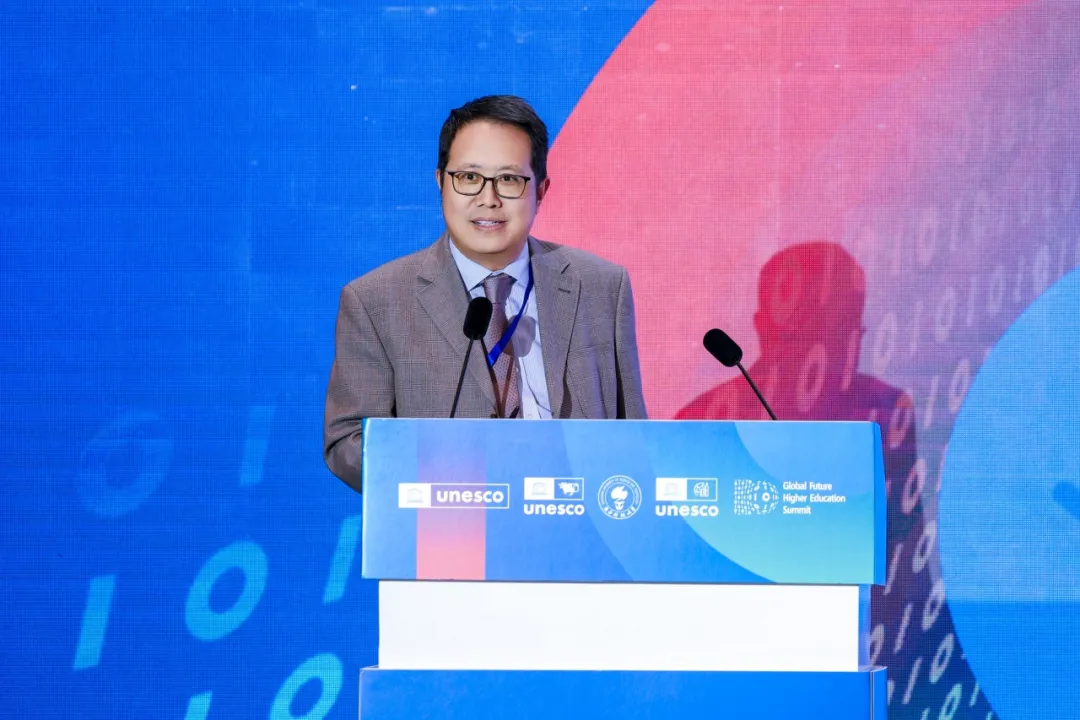
Professor JING Guifei, Vice President of CATIS, speaks at the joint launch of the "AI+Cross-Border E-Commerce" Micro-Certification Programme during the Global Future Higher Education Summit.
The Programme has developed a differentiated course system for three target groups: university leadership, educators, and students. Each course track can be selected independently according to the needs of different learners, responding respectively to institutional planning, teaching practice, and student learning and application. Together, the three tracks provide integrated support spanning the strategic design of talent development, course delivery, and the development of foundational operational competencies. The courses balance general applicability with local adaptation by incorporating real-world business scenarios, representative cases, platform-based practice, and AI applications, while allowing partner institutions to select and combine course resources flexibly according to their needs.
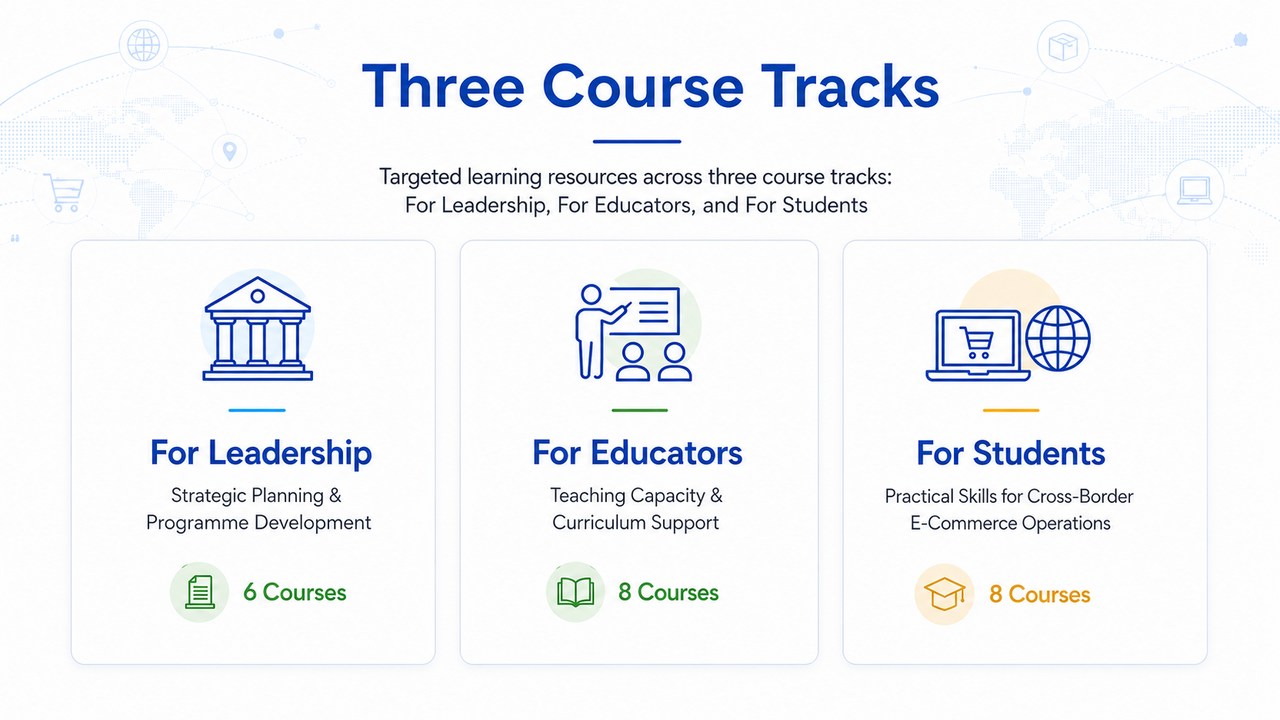
Course System for Three Target Learner Groups
Three Course Tracks
The six courses for university administrators support leaders of universities and educational institutions in understanding global trends in cross-border e-commerce and digital trade, as well as the new requirements that industry transformation places on talent development in higher education. The courses are designed to help administrators align cross-border e-commerce courses and talent development programmes with institutional priorities and regional talent needs, coordinate teaching resources, and explore pathways for industry-academia collaboration and international cooperation.
The course track covers the global landscape of cross-border e-commerce, cross-border e-commerce programme design for universities, and multi-platform operational strategies. It also introduces practical cases from three perspectives: China's experience in promoting cross-border e-commerce innovation at the national level, a Chinese enterprise's practice of developing local talent in Ethiopia, and approaches adopted by China's vocational education sector to advance cross-border e-commerce talent development.
Courses for University Leaders
The eight courses for teachers focus on the professional knowledge and practical content most relevant to cross-border e-commerce education. They support teachers in understanding the main stages of cross-border e-commerce operations and in translating industry logic, platform rules, practical cases, and AI tools into course resources and learning activities. By integrating professional knowledge, case-based learning, and practical resources, the courses help teachers strengthen their capacities in course design, teaching delivery, and guidance for student practice.
The courses cover seller operations, compliance and risk management, new marketing strategies, payments and settlement, operational data analysis, AI applications, platform simulation and hands-on practice, and a case study on teacher professional development in cross-border e-commerce education.
Courses for Educators
The eight courses for students follow the main business processes of cross-border e-commerce, from market entry to operations management. Beginning with accessible business questions, the courses help learners understand the characteristics of different markets and platforms, how products enter international markets, and how supply chains, pricing, traffic acquisition, customer service, and compliance management jointly shape cross-border e-commerce operations. Through the courses, students can build a foundational understanding of the full cross-border e-commerce workflow, develop an applied mindset, and prepare for further academic study, practical training, and career development.
The course content covers the global landscape and trends of cross-border e-commerce, platform selection and market entry, product selection strategies, global supply chains and logistics, pricing strategies for global markets, advertising and traffic acquisition, customer service operations across the full process, and compliance and risk management.
Courses for Students
All three course tracks are now available on the IIOE platform. Learners can log in to IIOE, enter the dedicated "AI+Cross-Border E-Commerce" section, and select courses according to their role, academic or professional background, and learning needs.
Programme page: https://www.iioe.org/#/news/detail/dfeadb57-13cd-4953-82f1-f945b9bb1ac0/0
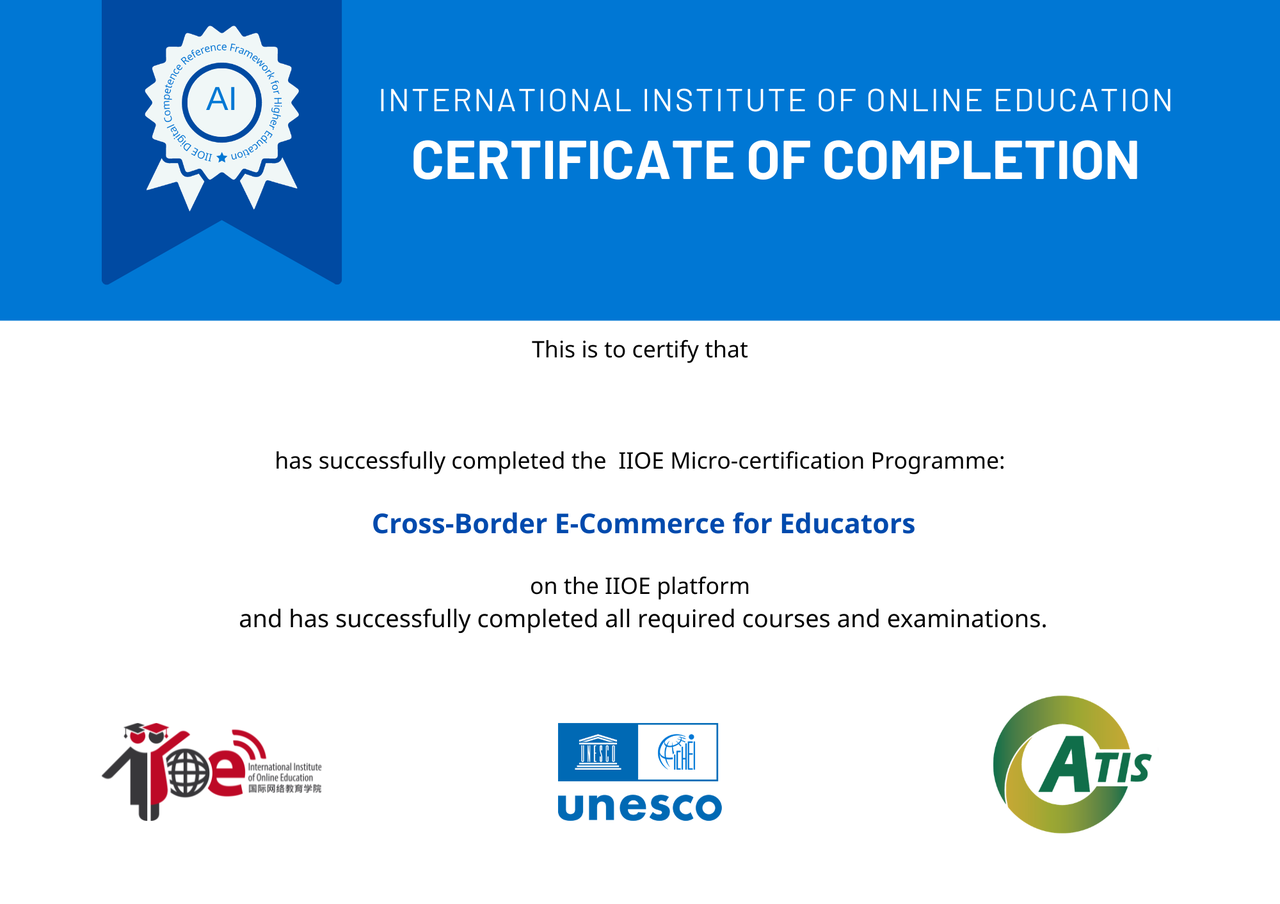
Course Certificate
Making the courses available online provides an important foundation for Programme implementation. As a next step, UNESCO-ICHEI and CATIS will work through IIOE National Centres, partner institutions, and relevant industry organisations to support localised implementation across different countries and regions. IIOE National Centres and partner institutions will play a central role in country-level delivery. This will include participating in Training of Trainers (ToT) to build core local teaching teams; leading the localisation of course content in line with national policies and regulations, language needs, and industry contexts; and integrating the Programme, as appropriate, into existing university curricula, teacher development, continuing education, and other talent development mechanisms.
IIOE National Centres and partner institutions will also engage relevant government bodies and industry organisations to explore opportunities for Programme endorsement and co-certification. They will establish partnerships with local and international companies to provide learners with practical projects and internship opportunities, further strengthening the connection between course learning and industry needs. Through these efforts, the Programme will better respond to different national education and industry contexts and strengthen its local relevance, recognition, and sustainability.
As an important part of UNESCO-ICHEI’s work to advance "AI+Industry" course development, the "AI+Cross-Border E-Commerce" Micro-Certification Programme will further leverage the IIOE global partner network to promote the sharing and application of quality educational resources in cross-border e-commerce. It will support partner institutions in strengthening relevant teaching and talent development capacities and provide learners in different countries and regions with more opportunities to participate in the digital economy through learning and practice.